
EWUCRT Hosts 150th Research Seminar on Machine-Learning-Assisted Photonic Design
Nov 19, 2026
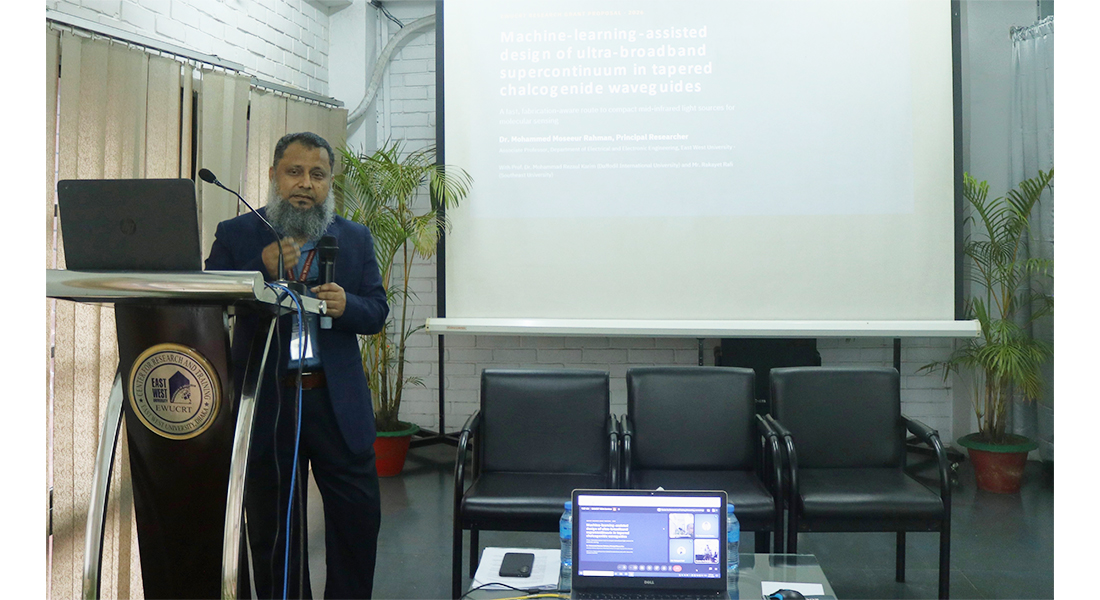
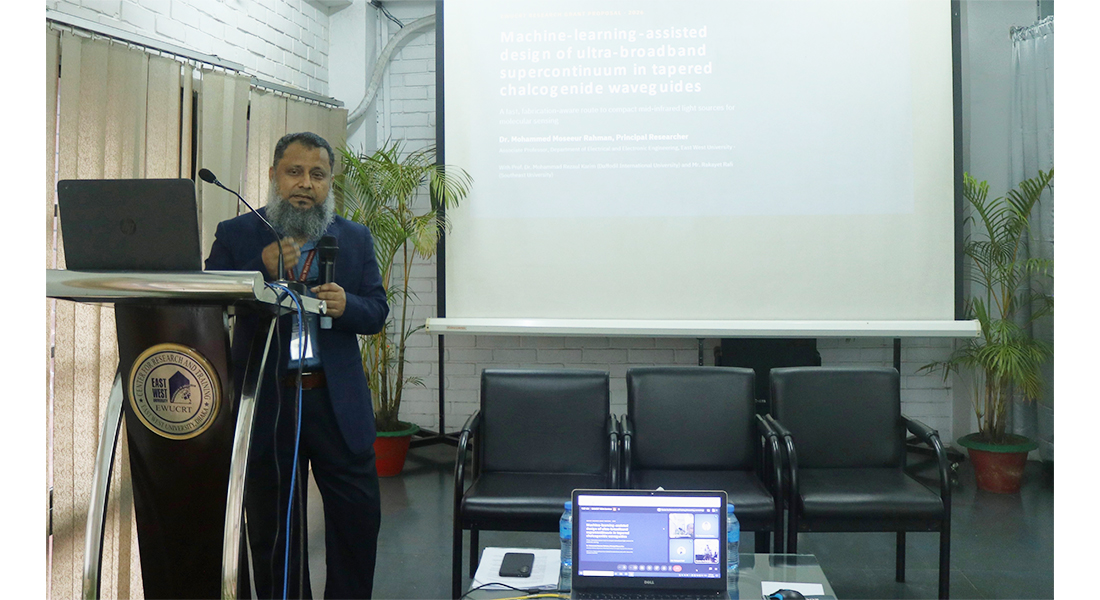
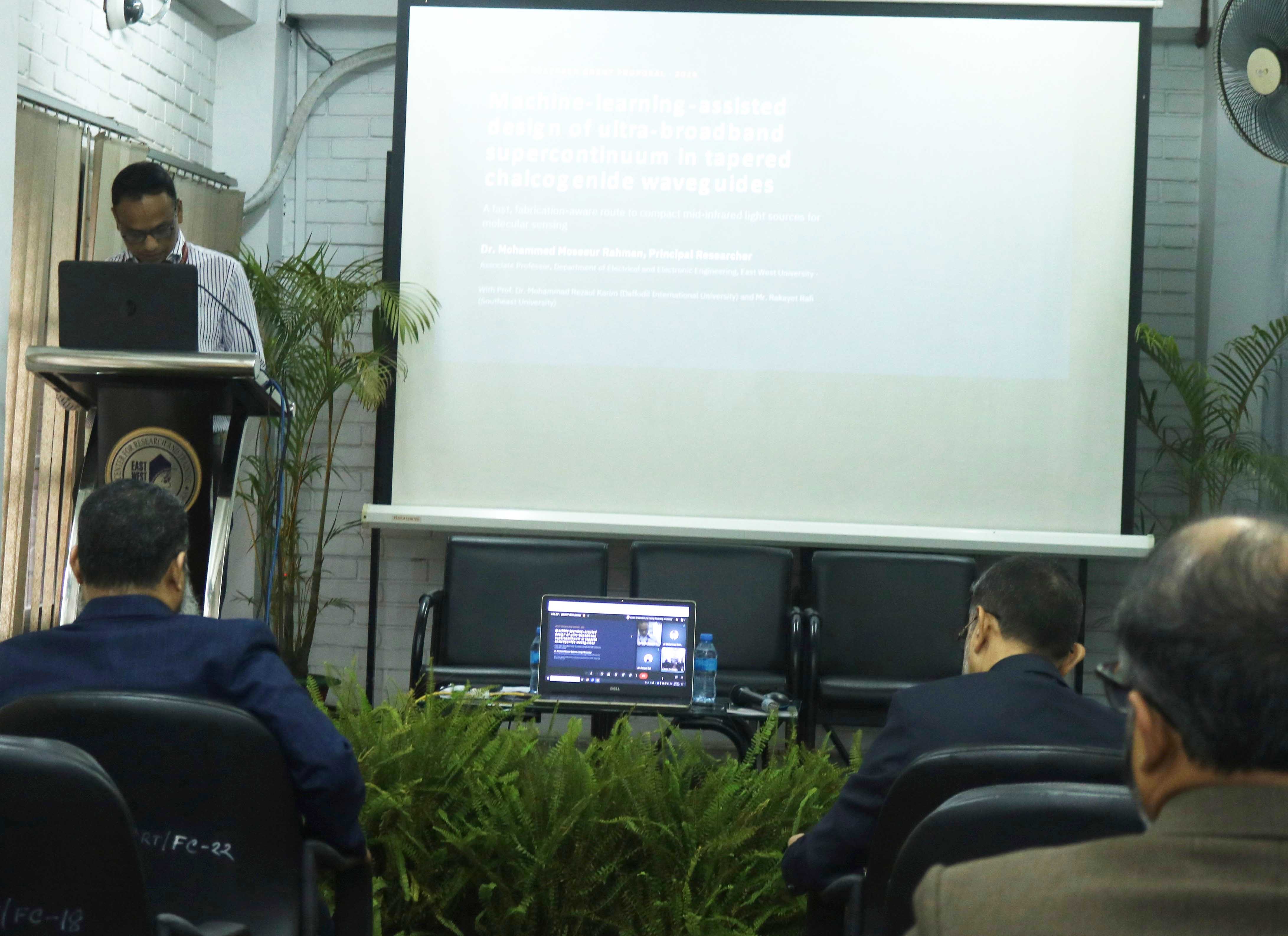
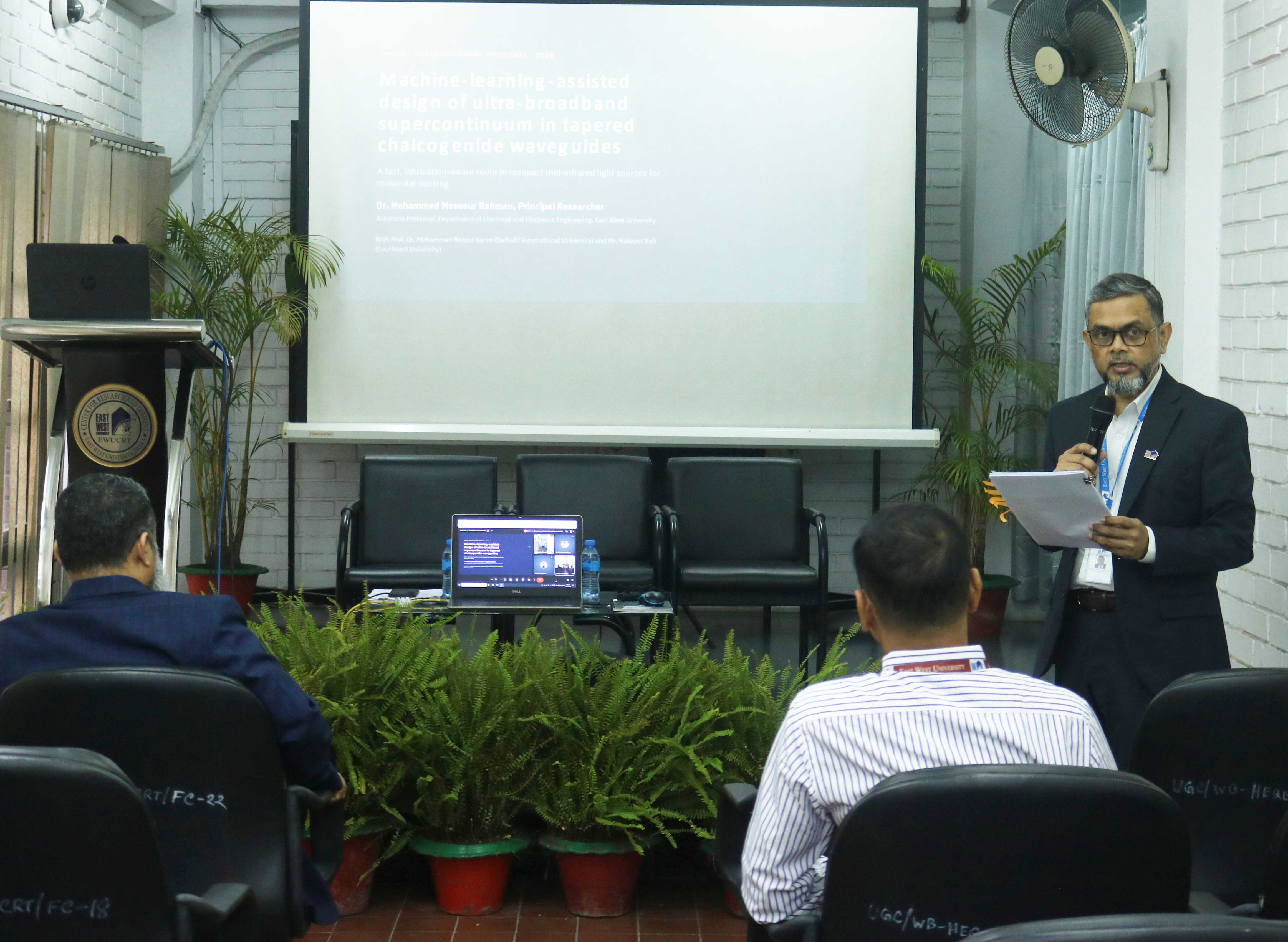
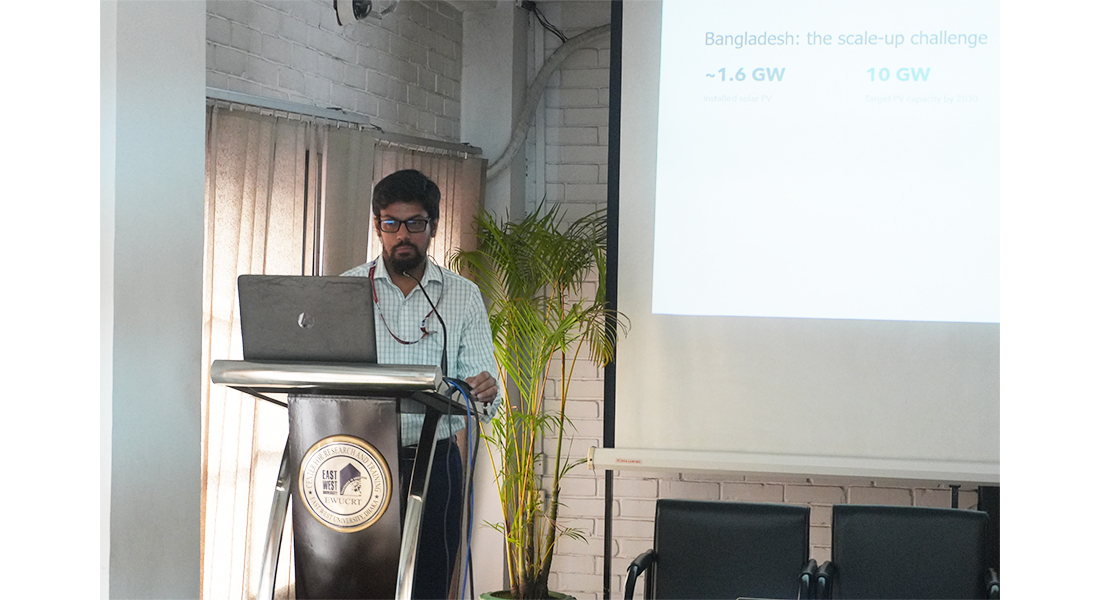
The East West University Center for Research and Training (EWUCRT) organized its 150th Research Seminar on November 19, 2026, at the EWUCRT Seminar Room in Aftabnagar, Dhaka. The milestone seminar featured a presentation titled "Machine-Learning-Assisted Numerical Design of Ultra-Broadband Supercontinuum Generation in Tapered Chalcogenide Waveguides for Mid-Infrared Molecular Sensing". The research was conducted by a collaborative team of investigators comprising Dr. Mohammed Moseeur Rahman, Associate Professor in the Department of Electrical and Electronic Engineering (EEE) at East West University; Professor Dr. Mohammad Rezaul Karim from the Department of EEE at Daffodil International University; and Mr. Rakayet Rafi, Lecturer in the Department of EEE at Southeast University.
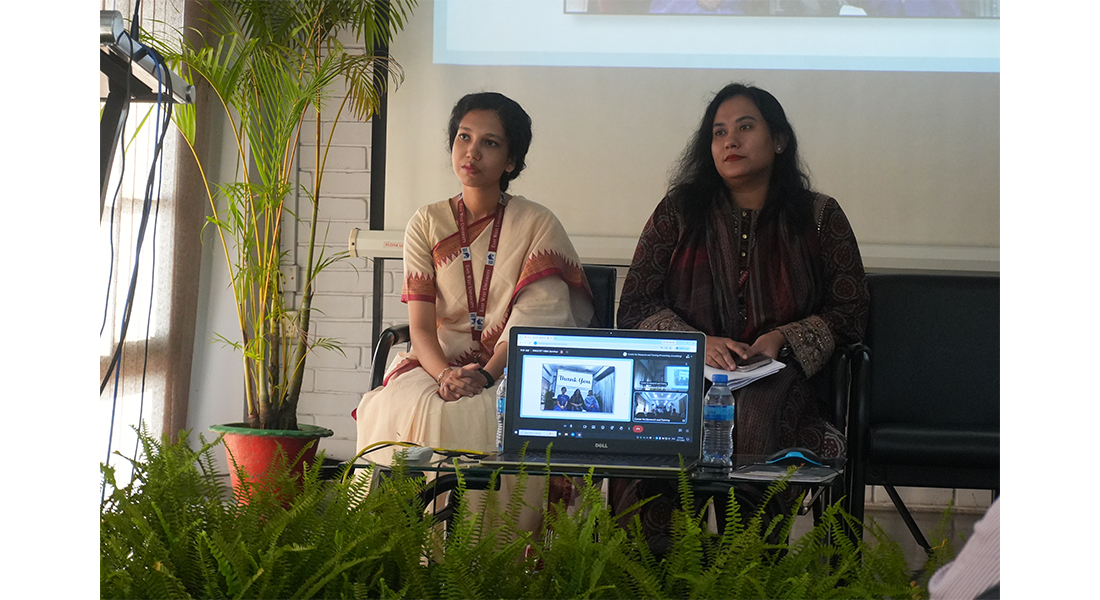
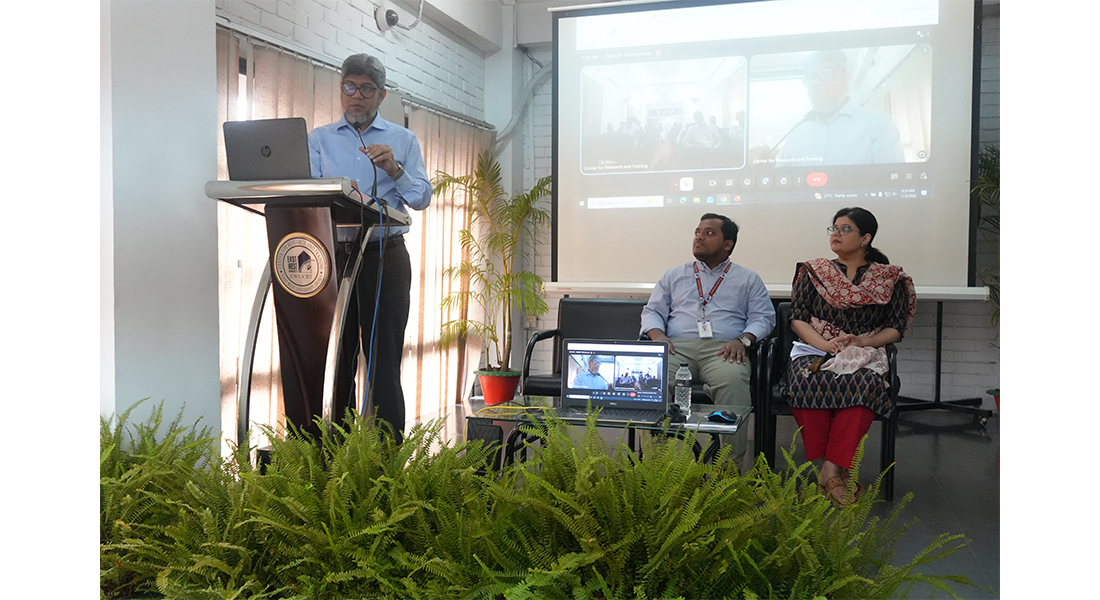
The session was chaired by Professor Dr. Mohammad Ashik Mosaddik, Vice Chancellor (Acting) of East West University, following introductory remarks by Professor Dr. Md. Sohel Rana, Executive Director of EWUCRT.
During the presentation, Dr. Mohammed Moseeur Rahman highlighted how supercontinuum generation (SCG)—a nonlinear optical phenomenon that produces an ultra-wide optical spectrum—is crucial for mid-infrared (MIR) applications such as molecular spectroscopy, biomedical imaging, optical coherence tomography, and environmental sensing. While tellurium-based chalcogenide glasses structured as tapered waveguides offer wide transparency and strong optical confinement, optimizing their complex designs traditionally requires computationally prohibitive trial-and-error simulations.
To overcome this challenge, the investigators introduced a two-pronged framework combining finite element method (FEM) modeling and generalized nonlinear Schrödinger equation (GNLSE) simulations with a physics-guided machine learning surrogate neural network. Targeting spectral coverage from
to
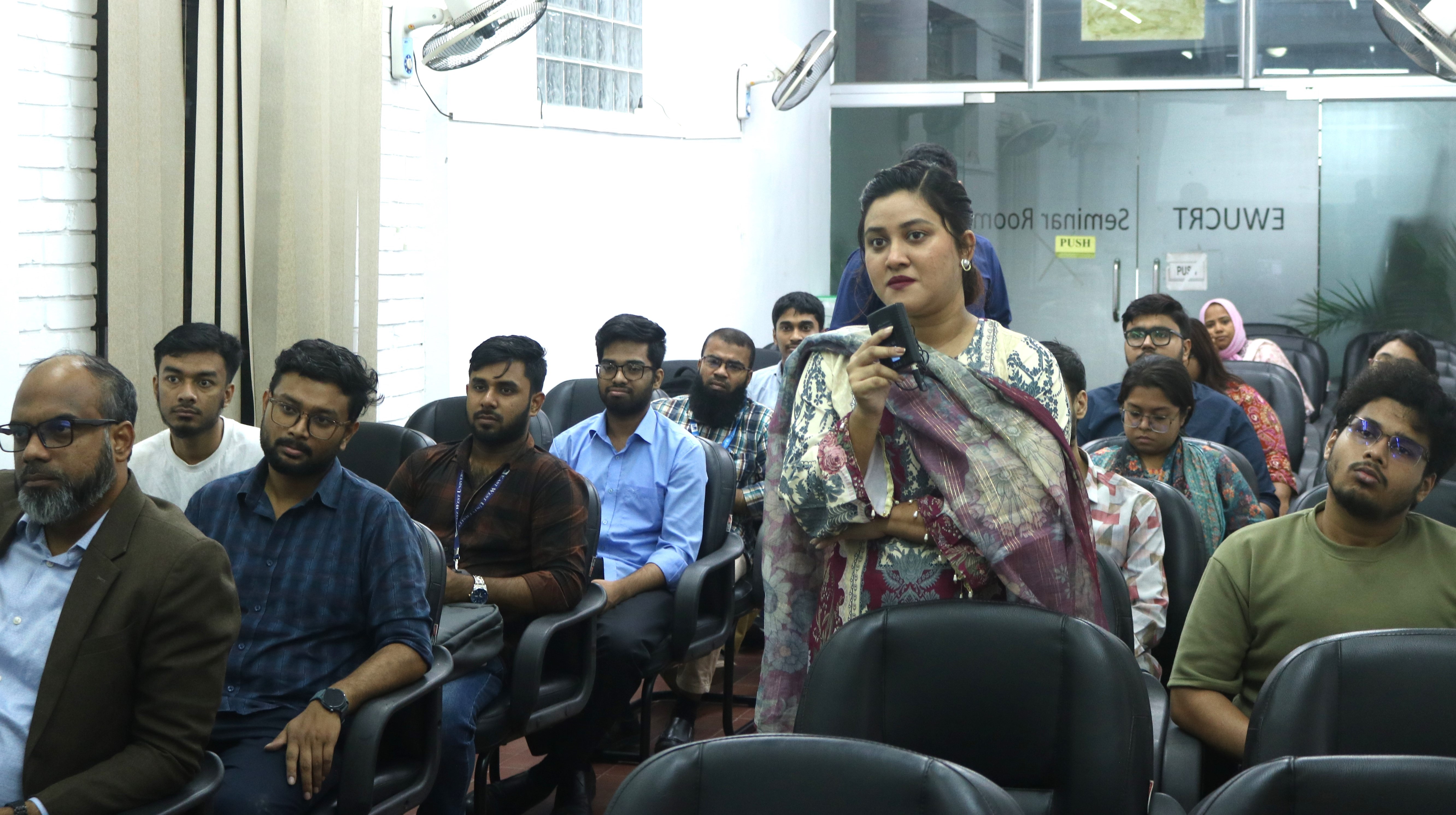
with noise levels below -30 dB, the machine learning model predicts key performance outputs—including bandwidth, flatness, coherence, conversion efficiency, and fabrication tolerance—in milliseconds rather than seconds. This approach reduces computational costs by several orders of magnitude and establishes a viable framework for developing next-generation compact MIR light sources. The presentation was followed by an analytical review from the discussant and an engaging floor discussion with faculty members and researchers, concluding with a formal vote of thanks.